Thursday, 10 October 2019

Thoughts about 'Two'

It has been a while since I watched a theatre piece as short as Two. 'Two' is a physical piece  co-created by  Pumelela Nqelenga, Samantha Hammerschlag and Nomcebisi Moyikwa. Two is a physical play about two sisters having to deal with sexuality, religion and the female body in a family structure. The play combines movement and shadow puppetry and the minimal setting is made out of iron board, a table and a hanger with wrapped apples on the ground.

The style of the play made me think of Neil Coppen's Tin Bucket drum and the sisterly relationship theme made me think of Matty & Sis. And the physicality of the piece made me think of Woza Albert.

But there is something fresh and necessary about the piece 'Two'. The play deals with  family dynamics, childhood idiosyncrasies and first experiences. The play has successfully managed to balance movement, text and shadow puppetry nothing is over done or less done having said that the emotional sustainability and depletion of characters felt unexplored.

Everything you see had a purpose on stage, however I could not connect the hanger with wrapped apples to the story. That part of the set was not co-operated to the piece. Was the hanger suppose to be a tree? If so, then it could have been a beautiful image when used in the narrative.

The use of body enhanced language and displacement of  pain and fear and metaphorical use of the dress highlighted the urgency the play has. The sisters's lives is told through flashback and memory.

Question such as which memory rest, where in ones body are vital because memory at times become the elephant that holds the body down... And both sisters are stuck and held by their own elephants.  The play bounces off from theme to theme and each theme is cemented by each character's conflict.

However, Two would have been more effective , when it would have been longer. The themes of religion and God, sexuality, family, abuse are vast  yet they felt squashed and summarised. The play has room for more exploration both the physicality and text. The text is amazing and convicts you to your own elephants but that on its own is quickly snatched away because the journey of both characters is not explored to the fullest.

There is much to win when they open the play and let it breath.  It was quickly gone as an audience I was left hanging without anything to go home with. The play felt like a quick summarised essay. I missed the ugliness, the joy, the quirkiness, the playfulness, the danger and the fear.

Both performers  Pumelela Nqelenga and Nomcebisi Moyikwa work well together like a well oiled machine. They commit themselves to the story and to the energy of the play. I applaud both of them  for their commanding focus and ability. I found the story of sisters quite relevant piece.  The play is running tomorrow at Squarespace Theatre entrance is free.

Pumelela Nqelenga in 'Two' Image: Katty Vandenberghe

Saturday, 15 December 2018

Thoughts about Woza Albert

Thoughts on Woza Albert
Woza Albert is an award-winning play written by Percy Mtwa, Mbongeni Ngema and Barney Simon directed Chris John. The play opened at the Playhouse Durban 6th– 30thDecember 2018.
The play is well written, it serves the build-up of the play, with punchlines and each character arch follows the through line of the story. It made the audience feel the need of Morena’s arrival.
As you enter the theatre you are greeted with minimal yet multi-purpose stage setting; two wooden square box inside the boxes it has few items used as props and behind it, there is a rail with different clothes hanging.
The two actors Bab’ Ngema and Bab’ Mtwa play roles of various black South Africans - a vendor, barber, servant, manual labourer, soldier - receiving the news that Christ (Morena) has arrived in South Africa where apartheid has foisted, and impoverished black lives. Christ's arrival trigger a crisis, and the government launches a bomb against the Morena.
 In the ruins, great South African leaders in resistance to apartheid such  as Albert Luthuli former president of the African National Congress, are resurrected. This play has crucial connotations events from the bible and structurally it shows influences of waiting for Godot.
Interestingly when the Zulu boy (exceptionally played by Bab’ Ngema) asked Morena (played excellently by Bab’ Mtwa) to raise the struggle warriors, the audience responded warmly. It reflected where we are as a nation we need a different Morena. 
In addition, I also felt that back in 1983 which that’s when the play was performed; this story was their reality and some of pieces of the story has become our reality in 2018.  
I am utterly grateful to have watched this play.  It was an experience to sit in the auditorium, waiting to see the original cast of Woza Albert playing at the Loft. 
It felt like a gift to be part of this monumental moment, witnessing the actors embodying different characters from a little boy to an elderly lady with clear precision and perfect synchrony of voice, body, sound, breath and movement, creating images using few words and action. 

Watching both actors excelling and sharing their talent of storytelling is astonishing and breath taking. I urge every actor in Durban to watch this play. Let’s fill up the seats… of the loft. 
Compu- ticket
6th-30thDecember 2018


Friday, 1 June 2018

Thoughts about 'ZemQadini'


Thoughts about 'ZemQadini'

by

Philisiwe Twijnstra

Watching last night's show made me realise that casting plays a pivotal role. You need an actor that will carry a story from the beginning to the end.This is what I appreciated with Msimango's work, he casted beautiful strong actors that complimented each other, both different from each other but they work well together like a tea in a pot.

Bhekani Shabalala, proves to be a treasure to keep, when I see him on stage, I always feel I want to join him. Bongani Mbatha does not fall short behind as well, one of the hard working theatre makers I have ever met. I could write so much about the actors'techniques, the actors'skill but watching them is more rewarding, so go witness it for yourself.

The premiering night of ZemQadini last night at SquareSpace Theatre, gave me exciting and satisfactory feelings which I appreciated.


The play is written and directed by Sboniso Msimango ZemQadini is a story that explores teachings of masculine behaviour to young black boys in rural and urban black communities in a post-apartheid context. What it means to be a man in a family and in a community - is one of the important questions that is posed by the story.
One brother is blind the other cousin brother can't walk and he is mute. Somehow they need each to survive, the play opens up with the blind brother doing his laundry, and the other brother lies down in bed not moving not talking. 

The story is a story within a story- the blind brother redundantly tells about the conflict that erupted the war into their families and how both cousins from both rivals became each others' survival kit. 

The set is simple,upstage centre there is a bed and stage left center there is a chair and they use props to help change characters.

The play was good, but it has so many rooms to develop, few things could make the play even heart cuttingly stronger, already the concept of the story is quite interesting if not intriguing.
The script has loopholes, the conflict and structure needs reworking. 

Msimango proves to have a nag to write neat dialogue but sometimes we get thrown in beautiful lines and forgetting the conflict, the structure that would help with the anti-climax.

We need to pay more attention to writing and taking time to re-writing plays, and this means having a culture of mentoring plays. I strongly think the script needs more drafts.

I felt that it was a bit to much to use live musicians, it didn't help the play instead it felt like a second play. My suggestion would be trust the actors, use the actors body let them be the story. We need two of them on stage kuphela! 


I know as theatre makers we get caught up in trying to be fresh but sometimes the piece works well in its simplest form. No gimmicks, No drums just the actor's voice and body. Trust that more.

I urge Durbanites to watch the play, it was refreshing to see actors playing and diving. Durban needs this, the play is 50 minutes long. Well done to everyone involve.
 

Tickets R60

31 May - 02 June

Square Space Theatre

18:00


Sunday, 6 May 2018

Thoughts about 'how Long'


With this post I am not bashing anyone or intending to disrespect anyone but I am mainly responding and reflecting. Nor what I say or write intends to offend anyone.

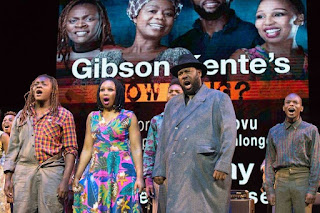
There is a huge difference between hopes and expectation. And last night I had high high high expectations and I truly didn't expect anything less because of who Bab Gib was to black theatre makers. He discovered a lot of South African icons.

He nurtured a lot of Icons we celebrate today, icons that are fearless, talented and daredevils. Some of them were in the audience, and most black theatre makers are influenced by his myth. I think most black theatre makers can't go around Gisbon Kente like most Europeans can't go around Stanislavsky, grotovsky and Peter Brook. He was a king of township theatre, a business man. He was a money maker.


I just want to say that the expectations were unbelievably high.

Bab Gibson Kente's work was not only about a beautiful voice, it was about emotion, audience and the social injustices. But there was something else, the actor cocooned the audience's emotion. One of the amazing things I have heard about him was that he knew how to work the actor to work. Body fit. Articulation perfect. Every word mattered. Every syllable had life. Every breathe had its place in an actors'body.

Stage presence always had to go hand in hand with alertness and being present, being in the zone. Eyes should shout, teeth, lips, tongue and the whole flipping mouth should work, the whole body sings.

'How Long' was produced 45 years ago and it was never done again. This was way to long. So you can understand the need and excitement to see this work on stage. It is bound to be emotional.

"How long" is a story that focuses on a dustman, Thwala played by who is battling to find enough money to keep his son Afrika in school, especially since he has successfully passed the JC exam. However, Africa does not have a passbook and this is a serious offence in the eyes of the police.

I won't talk about how weak the script is because this is our archived script there is no rewrite, there is no fixing, this is our history. Take it and Love it as it is.


The play is set in Soweto 1972 written by Gibson Kente directed by Bab Duma Ndlovu.


Bab' Duma Ndlovu is an interesting, pivotal figure in the industry.

The only theatre show by Bab Duma Ndlovu that I have seen is 'The game' Which was an excellent piece of theatre, for what it was. But honestly that was the only theatre piece I know by him, I'm not really familiar with Bab' Duma Ndlovu's theatre work that much. I wish I could.

I salute and respect the opportunity that Bab Duma Ndlovu and the playhouse theatre has given the audience of Durban. For this musical to be revived and celebrated. Indeed this is a great timing for the country. I also personally think it's good for high schools and primary schools to know about Gibson Kente's work. That is why I concur with a lot of friends that have said 'when you do Gibson Kente do it well and really well.'Especially for those who had no idea who Bra Gib was.


So perhaps now you're curious about what I saw last night.


Last night felt like an amateur sketch music play. I don't know what I saw last night, oh wait I might have seen singers just singing, dancers who were competing with each other, it felt like an audition choreography. "Ngifuna bangibone kinder dancing." messy, messy blocking, walking in, stand walk in, let's mime and pretend as if we talking, let's use our hands, lets mime again, oh lets laugh again oh! the cue is coming, let's move to the position of the next dance piece. The scene to scene transitions were to messy like my Afro in the morning and to many- if not trillion black-outs.


Beautiful music was just that beautiful. No emotion, no colour, no rawness just actors on stage using their gimmicks. I know, I will get into trouble because of what I'm saying.


But this is just my two cents thoughts, and my truth---go for yourself and watch it. And experience it for your self. I wonder whether during rehearsals did the director invite actors/dancers/proteges of Bab Gibson Kente that have worked with him to inspire and master-session-class the company about how it was done. Maybe it's because of the first night premier nerves, maybe, maybe not, however I do not think the blocking, the set, the light, the rewriting of the script is nervous as well, or is it?


Baba Gibson Kente 's work does not only entail a beautiful voice I'm really young and I have so much respect for people who have paved and weaved a way for me in this industry to even understand the body on stage.


Baba Gibson Kente is hailed as the father of township theatre. I always wanted to understand that, to see his work live on stage. But what an utter disrespect to people that knew his work, worked with him, studied his work, took his work as breathing and I hope last night would have been a night of excellent but unfortunately it was not. I cannot speak of the director's choices, as an audience, a theatre maker and a human being with feelings, I sat there on the third row, I had good seats by the way, I constantly felt there was no need to try contemporaries.(Is that even a correct word to use?)


I say this because already the audience makes it contemporary enough, the orchestra makes it contemporary enough, the actors were contemporary enough, the stage was contemporary enough, the light were contemporary enough. So please respect the script as it is, and the music as it was and those are just my thoughts.


Lastly, I want to mention two actors astounding performances by Nqopho as Nyakanyaka, and Mama Thembi Jones Mtshali. Nqopho held it together his character was consistent and believable. His timing was on point he engaged with the audience, he allowed and played with the audience. Mama Thembi Jones Mtshali just by walking in she knows the audience, I loved how she supported the young actors and goodness lord almighty she has an amazing uplifting, full of emotion kinder voice having said that, I do wish she could have sang more especially the scene at the bus stop. What a powerful moment! The light there is excellent.


To close off, I am not the director of the show, therefore I have no idea what goes on or went on, but I guess the director had his vision and I was taught to respect that. Believe me I do. But you only know this if you finish reading my reflection post. 


5-27 May 2018
Tickets R100-R150
Opera Theatre The Playhouse

Image Val Adamson


Thursday, 12 January 2017

A minute with Fresha Festival Participants 2017

Durban newest festival, Fresha Open Air Festival which takes place from the 20 to 23 January 2017. As we know January is a quiet month for an artist, this festival has come at the right time. This festival is not your typical indoor, theater safe seating kinder festival. Although conversely, It is theater.It is aiming to be fresh, fun, creative yet it is mostly performed outdoor; Mime, Comedy, Physical Theater. It is quite exciting that this festival will encourage artists to think outside the box and don't rely on venues. Because sadly venues turn to close down.  
BlackOut had a minute with each participant. BT


Blackout. 

Why should people watch your piece? 


Sibo Masondo The Mime Artist
Because it is a piece that expresses itself in the universal language of mime which is space, magic, and art. Because I am Deaf and want to create awareness of my art form! Because it is an innocent adventure for all!  


BlackOut. 

What does it mean to be part of fresha Festival? 

Sibo Masondo The Mime Artist

It is a privilege and an honor to be part of something so cool for Durban’s people. 

Sibo Masondo

BlackOut.

Why should people watch your piece? 

Isil Vos

Hit and Run is a crazy, fast, musical and absurd performance. A beautiful character, Lady G, played by the very talented Willemijn Haasken, a Dutch actress. You will never ever forget her once you've met her. 

BlackOut.


What does it mean to be part of fresha Festival? 

Isil Vos

Durban and I met last year when I was invited to play the clown performance CHARLIE at the Isigcawu Festival.We immediately fell in love with the South-African audience, the highly talented and engaged actors and directors and we promised to come back. Now we are honored to be part of the very first edition of the Fresha Festival! Hopefully, there will be much more!


Willemijn Haasken as LadyG

BlackOut.

Why should people watch your piece?

Doung Anwar Jahangeer

People should watch our piece because the piece will give them the opportunity to witness self-introspection.

BlackOut.


What does it mean to be part of Fresha Festival? 


Doung Anwar Jahangeer

Giving people the opportunity to experience how artistic practices can create dialogue around social issues and change.
Doung Anwar Jahangeer

 BlackOut.

Why should people watch your piece? 

Gerald O
I like to show people, a different way of making street theater which it's a street theater with a surprise.  And for me, they're no boundaries especially when it comes to making art.

 BlackOut.

What does it mean to be part of Fresha Festival? 

Gerald O

Being Part of Fresha Festival is a great pleasure because I get to meet and work with a disciplined, motivated artist. I like how south African artist think when they create theater. Theatre is not the easiest form of art, however, the exchange of ideas and thoughts makes it the most enjoyable. 


Gerald O


 BlackOut.

Why should people watch your piece? 

Shelby Strange
Is to be part of a new Durban initiative with a fresh approach to exposing people to performing arts. It is exciting to temporarily inhabit a public space, interact with the place and the people. 

BlackOut.


What does it mean to be part of Fresha Festival? 

Shelby Strange

To enjoy and engage with the incongruous images and displaced characters inspired by Durban's landscape and history.


BT.

Wednesday, 20 July 2016

A minute inside VaVasati International Womens' Festival


BLACKOUT: 
What is the festival about?

Vavasati (a Xitsonga word meaning women) is a festival that symbolizes the power that overcame the struggle of women in the 1950’s. Her-Story was written when 20 000 South African women, of all races… from all backgrounds united and marched to the Union Buildings on 9 August in 1956, against the pass laws. The South African State created this festival three years ago as a platform that can celebrate female artists or works focusing on female narratives. 


BLACKOUT:
How long has it been running?

2016, would be the fourth year of the Vavasati International Women Festival 

BLACKOUT:
What makes the festival different from any other festival?

Vavasati is one of the few Female Only Festival in the world, focusing on women creatives and their works. I jumped on it late this year… and I am literally working on a zero budget. I still believe and see the significance of a platform like this one, that aims to bring more than 1000 female delegates and participants who will be part of our various theatre shows, workshops, exhibitions, and activities; giving audiences a window into what women artists are doing, making, thinking and writing about in the contemporary world.


BLACKOUT:
What is interesting about the festival?

This year marks 60 years of the strong threat of feminine unity that inspired so many young women to hold the knife at its sharpness and collectively embrace the significance of not being silenced creatively. And it is also the first time the festival is being curated by a female director since its conception. Which I feel makes the layout and artistic plan completely different and more feminine.

BLACKOUT:
Who is the curator of the festival?

(LOL!) Napo Masheane. (Let me refer to me in the third person for a change). 

Napo Masheane was a founding member of the Feela Sistah Spoken Word Collective and with its demise, she went on to become one of the nation’s leading black women theatre-makers. With her roots sunk deep in spoken word and theatre, she moved to mainstream stages when she wrote, directed and produced plays such as, My Bum Is Genetic Deal With It, Fat Black Women Sing, Street Light With Lips, A New Song & presently Mama The Storm IS Outside. She further organized women artists between USA and SA in a project called Colours of the Diaspora. In between internships, directing shows on cruise ships and study opportunities she also completed two poetry collections, Caves Speak in Metaphors and Fat Songs for my Girlfriends. Napo won the first Mbokodo Award for Women in Theatre Category and Pan-African Language award and SAFTA’s for Umlilo. She has just completed her Master Degree in Creative Writing from Rhodes University.  Picked up on the international circuit, one of her monologues was chosen to be performed by leading actor, Chiwetel Ejiofor (12 Years A Slave).  She just became the first black women to stage and direct a play 'A New Song' mentored by Royal Court London, at the Market Theatre. 


BLACKOUT:
Do you have a website?

Our website is being updated so it’s down… but people can get hold of me on:

Twitter @popomasheane
Instagram @popomasheane
FB: Napo Masheane

And for more info on Vavasati International Women Festival:

Twitter: @VillPro
Instagram: @vill_pro
FB: Village Gossip Productions

Twitter: @sastatetheatre
FB: State Theatre


BLACKOUT:
What procedure do you follow in selecting a production?

I sent out a call out within my art and theatre community… and based on submissions, I looked at what was “Relevant, Reflective, Engaging, Provocative, Different, Outstanding and Contemporary”

Friday, 13 May 2016

A minute with Festival Internacional Teatro de Inverno.


BLACKOUT: 
What is the festival about?

FITI:
FITI -Festival Internacional Teatro de Inverno(An international Theatre festival of the winter) is an international event that involves national and international companies with the objective of providing the platform for international Exchange and divulge the artistic products of theatre groups. The festival is also concerned about opportunities for training and workshops about direction, dramaturgy, choreography, and associative. The festival production and funding are also the matter of this festival. In order to include more audience, we have parallel realisations of music, visual arts and another form of artistic manifestation.


BLACKOUT:
How long has it been running?

FITI:
FITI -  has been realised since 2004. Firstly was the only amateur festival for Maputo city and progressively went to regional and now in an international.

BLACKOUT:
How did you select a South African play? 

FITI:
Mahamba company, led by Dado and Maria was invited to Musho Festival in January. Dadivo has been our partner in this festival and we asked him to see the possibilities of bringing south African company for this festival. Is our aim to extend the possibilities of international participation although our financial difficulties. As we knew from Dadivo, he watched a very good performance during the festival but he decided for one that would encourage our actresses and women director to grow. That is why he selected the one that is 100% percent female production. Of course, the performance itself is very good.

BLACKOUT:
What is interesting about the festival?

FITI:
International exchange, training, and workshops. Also the cultural tourism

BLACKOUT:
Who is the creator of the festival?

FITI:
Associação Cultural Girassol,  Joaquim S. Matavel (Dramaturgy e Endeavor)

BLACKOUT:
Do you have a website?


BLACKOUT:
What procedure do you follow in selecting a production?

FITI:
We have the editor which sends out a call for artist's that want take their productions for the festival. They can fill the form, send the pictures and the short video or casting.